The Aerospace Dilemma: Do Engineers Trust Digital Material Databases?
A candid conversation with a client about the realities of FEA, certified labs, and speeding up R&D.

Welcome to Engineering Solved which is a Substack page of BanuMusa R&D. I am Mohamad Khorashad and I wrote these news and blogs. This time, I want to share a fascinating message I received from a senior engineer who recently purchased MatLib (our premium Abaqus material library).
His feedback was so insightful that I felt it needed to be shared with this community, as it touches on a reality every R&D engineer faces: The battle between fast simulation and certified physical testing.
Here is what he wrote:
“Congratulations on the excellent work with MatLib! That said, in the aerospace industry (and other demanding sectors), customers usually require material properties validated by their own partner laboratories. Sometimes, they trust the name of the lab even more than the quality of the calibration itself! 😄 Have you managed to convince highly demanding industrial customers of the value of this work?”
It’s a brilliant question. And if you work in aerospace, automotive, or defense, you know exactly what he means. When it comes to final certification (like FAA or EASA standards), the stamp of a certified physical laboratory is non-negotiable.
So, how do we position MatLib for these demanding industries? By completely changing the timeline.
We Don’t Replace the Lab; We Accelerate the Journey There.
In high-stakes industries, the final physical test is the finish line. But the race starts months, sometimes years, earlier in the Preliminary Design and Prototyping phases.
During this R&D phase, FEA engineers need to run hundreds of simulation iterations. If an engineering team has to wait for custom lab tests for every single design tweak—or worse, if they waste weeks hunting through literature for baseline properties—the project budget and timeline will collapse.
This is exactly where MatLib becomes an indispensable tool.
By having instant access to over 1,400 validated material datasets directly inside Abaqus, engineering teams can:
Establish a Reliable Baseline: Quickly test different materials (from hyperelastic rubbers to advanced composites) without manual unit conversion errors.
Optimize Before Testing: Refine the design virtually so that when the prototype is finally sent to the expensive certified lab, the chances of failure are drastically reduced.
Save Weeks of Setup Time: Let engineers focus on analyzing the stress contours, not manually calculating density units.
The Custom Calibration Route
Furthermore, we shared with him that BanuMusa R&D doesn’t just sell the software. Many industrial clients come to us with their proprietary, certified lab data. We perform the complex material calibration (such as Hashin damage or GTN models) and package it into a secure, customized version of MatLib strictly for their internal team.
What’s Your Workflow?
This conversation reminded me of why we built MatLib in the first place: to bridge the gap between academic theory and the brutal speed of industrial R&D.
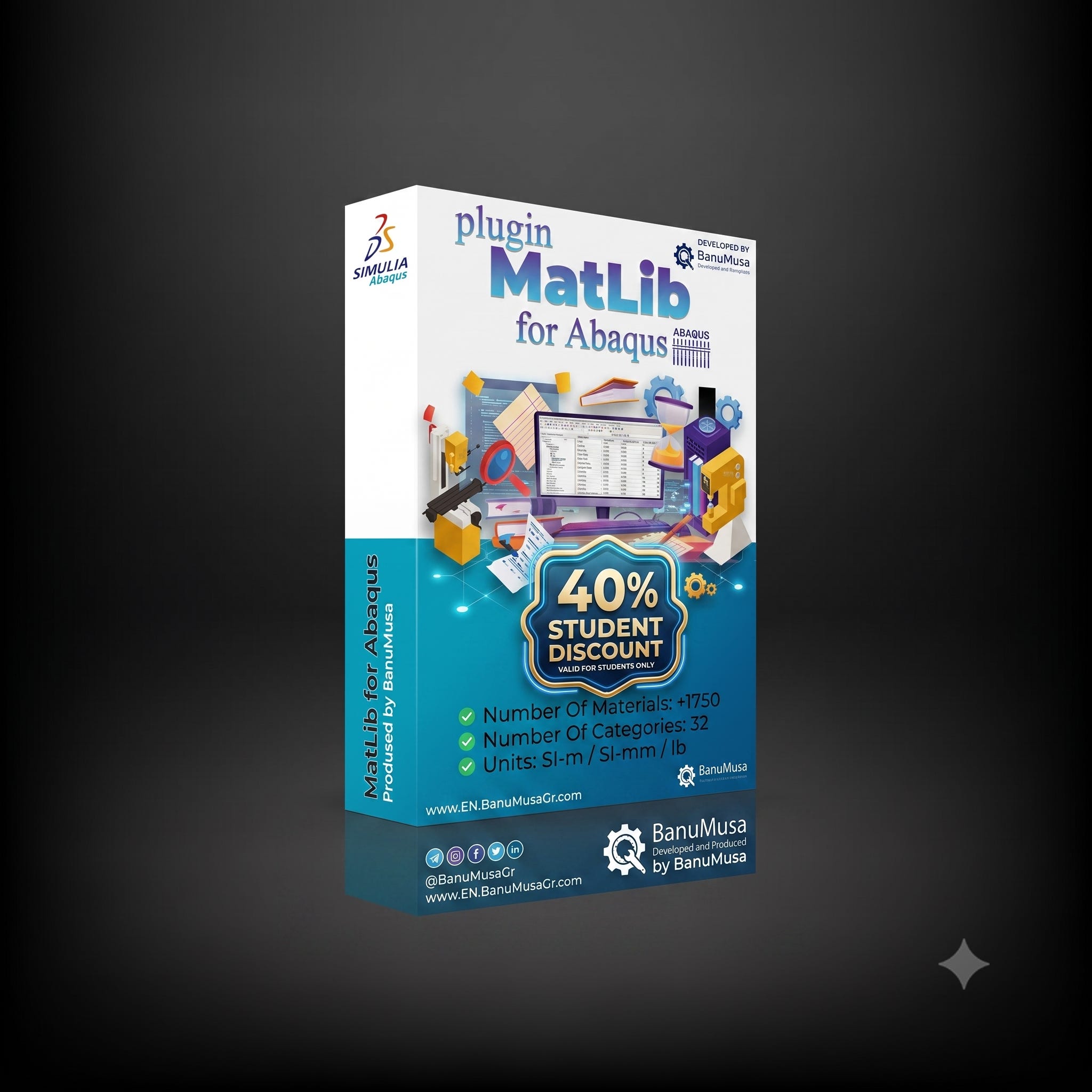
If you are tired of manually calibrating materials and want to see how MatLib can accelerate your Abaqus simulations, you can check out the full features here: 👉 Explore MatLib for Abaqus
(And a quick reminder for our academic subscribers: You can still apply for the 40% Academic Discount on MatLib through our website!)
I’d love to hear from you: How much time does your team currently spend searching for reliable material properties before running a simulation? Hit reply and let me know!
Until next time, keep innovating.
Mohamad Khorashad CEO, BanuMusa R&D